As we all know, Samsung has recently been at the centre of a rather large set of patent disputes with Apple. Typically any form of legal dispute has a harsh and serious effect on the way that company does business; it turns out, not for Samsung.
This advertisement has emerged in an Australian news paper, calling the Samsung Galaxy Tab "The Tablet Apple tried to stop".
As well as this, Samsung has declared that the publicity generated from the disputes alone, has made "Samsung a household name" according to Samsung Australia vice president of telecommunications Tyler McGee in The Sydney Morning Herald.
Apple (Cupertino, CA) has had numerous patent disputes with Samsung in the past year, leading to (near) sales bans of Samsung devices in many countries. Apple recently had an injunction that banned the sale of the Samsung Galaxy Tab inAustralia, that was lifted on December 9th.
Steven Paul Jobs. A man who himself would not believe his level of success. He set out to change the world. Very few people that set out to do so actually achieve their goal. He did. He saw beyond the present more than anyone else and laid the foundations for all aspects of our personal relationships with technology today.
He saw technology in ways that nobody else has ever done. He has always got it right. He made technology so complex but simple to use. He made us smile when starting up a computer. He realized that as important as it is to cram the biggest and best technologies into products, he also recognized that it’s just as important to hide it from the user. As he taught us that “a computer is like a bicycle for our minds” he wanted anyone and everyone to utilize these tools without any work or training. To be able to step right up to that Macintosh 128k or that iPad and begin using it to its fullest, almost immediately. “It just works” is something he has said many times. That’s the thought that comes to mind when using an Apple product, it works. It does what you want it to do in the natural way your mind expects. Nothing gets in the way.
He realized the importance of design when manufacturing our devices. How important it is to make something look nice, like a building that not only serves its purpose, but looks incredible too. Why? Because then people enjoy going in that building or using that device. This makes a difference to people’s lives. A bold statement I know, it does. Great design makes us happy. His philosophy on design is to remove what you don’t need. To keep things simple. But, this makes things so powerful. Perhaps the main reason for this incredible level of design is something else we come on to.
Perfectionism. Maybe he is the greatest perfectionist since Walt Disney. Steve Jobs cannot, has not and will not allow anything that just “will do” to be sold with an Apple logo on it. As he said “we don’t ship junk”. When creating products he made them the way he would want them. He made them for himself. He made things the best he could, he made products the way he did because he wanted a phone or computer that looked so incredible and at the same time worked so well. Perfectionism is his greatest habit and he could not allow himself to make a third-rate product.
Using a Dell or HP PC running Windows? Carry an Android phone? You wouldn’t if it wasn’t for Steve. He created the foundations for what those devices are and what they do. He created the PC and he created the smartphone as we know it.
He is different. As with us different people, we often have big ideas and nobody believes in us. But Steve taught us to ignore them and that “the people who are crazy enough to believe they can change the world, are the ones who do”.
You have taught me so much in life. You have given me faith when I have been looked down on for being different. You have given me the faith that it is possible to do anything and that I can one day make a difference in the world.
I hope you once again pull through with your health issues. You still have had so much to give.
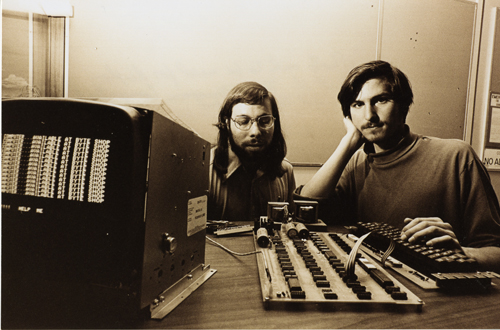
April 1st 1976. Two young men were putting together a little computer that was to be the start of a revolution. Steven Paul Jobs and his friend Steve Wozniak (Woz) had begun a journey which was to change the world forever.
Woz just wanted a computer that he could have for himself. Computers at the time came in metal boxes the size of the room you’re in right now and only people with a degree on how to use a computer were the only ones who knew how to use them. But Jobs saw that these electronic devices could be one of the most useful tools in the history of mankind and simple enough to use, so everybody could utilize the power.
The Homebrew Computer Club: a group full of geeks in Silicon Valley at the time, was where it all began. Steve and Woz did everything to make "The Apple 1 Computer" possible. Steve sold his VW Camper van to buy parts for the computers and their first production plant was Steve's parent’s garage. They began to sell the units to local electronics stores and members of the club, this made a profit. For the first time people could buy a pre-assembled computer at an affordable price.
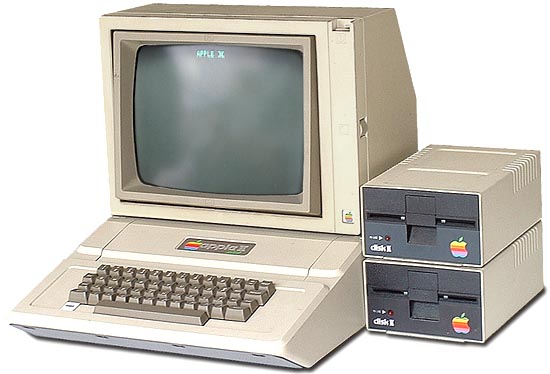
The company was officially incorporated in 1977 as Apple Computer, Inc. In that year they designed the Apple II Computer, arguably the first Personal Computer (PC), the Apple II was the first computer anyone could buy (at a price of $666) and the first anyone could use without any prior training. Steve and Woz wanted to make a statement by having the Apple II as the first computer in a plastic case, "like a TV set" as Woz said. At the time Apple was the largest Personal Computer company in the industry, but at that time however, there wasn’t much of a personal computer industry as it was mainly business that used PC’s.
In the early 80’s competition came for Apple as others like international computer company, IBM started to move into the Personal Computer industry. However there was still a problem with the idea of computing for the masses; computers still seemed boring and technical to use, people weren’t going to invest into something like that for the home. There needed to be something that would make computers more effective and consumer friendly.
Xerox 1979. A team of engineers at Xerox in Palo Alto created a computer called the Xerox Alto, which included something called 'WIMP' (Windows, Icons, Mouse, and Pulldown menus). This is what we know today as the Graphical User Interface (GUI) and every consumer operating system, like Windows and Mac OS X uses this as the main way for the user to use the computer. Xerox never saw the potential in this invention and it was never released to the public, but on a visit to a demonstration at Xerox, there was someone who did. Steve Jobs knew this was the way forward and decided to create a consumer computer with a mouse and a GUI. Interestingly, Bill Gates was also at this demonstration, but the GUI only made its way into Microsoft in 1985, in the form of Windows 1.0 (Apple sued Microsoft over this).
The Apple Lisa released in 1983, was the first consumer computer with a mouse and a GUI. The problem was that this was $10,000 and rather big. Steve needed to create something that was consumer friendly.
As IBM began to dominate the industry, Apple was designing something that would make history. The Apple Macintosh was unveiled to the world on January 24th 1984, a historic day that, I believe should be taught in history lessons! Your probably using a Windows PC at the moment and Bill Gates wouldn’t mean anything if it wasn’t for the Macintosh. Before this, to use a computer most people had to type text commands to run an application. For the first time, normal people could pick up a mouse and naturally move the cursor to whatever they want to open, run, etc. See the video below to view the amazing unveiling of the Macintosh in 1984 -
This is how Microsoft Windows came around, and because of that how Apple failed. Soon I’ll continue our look into the career of Steve Jobs and how he came back on top in the 2000’s.
The predecessor to the Graphical User Interface is featured in this video of Douglas Engelbart, who invented the mouse and the idea of a GUI.